
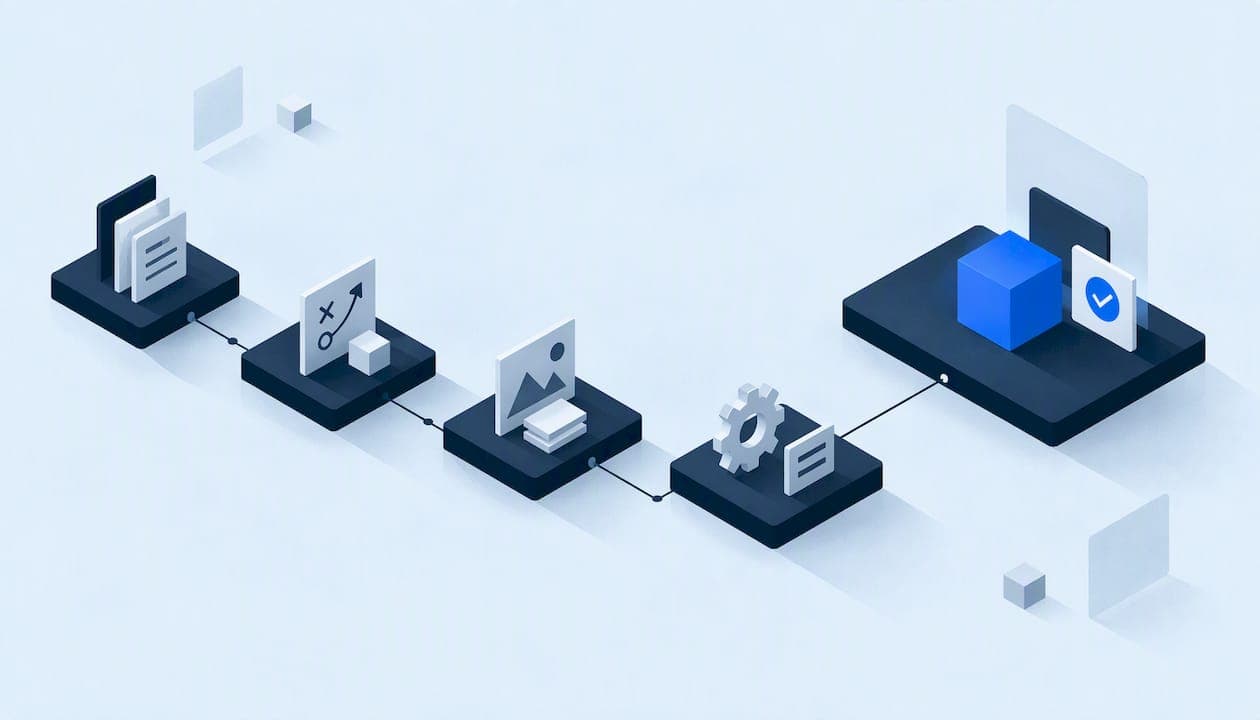
A marketing agency workflow is the agreed route a piece of client work takes from first enquiry to final sign-off: who does what, in which order, with which information, and who approves it. The best workflows are not clever. They are written down, they give every task one owner, and they make sure the client's information arrives complete before production starts. This guide walks through the stages, the roles, the review loops and the handover, with a particular focus on the stage most agencies leave to chance: intake.
TL;DR
- An agency workflow runs through five broad stages: discovery, planning, execution, monitoring and closing. Intake sits at the start and decides how smoothly the rest goes.
- Give every task one owner and one due date, and write down who approves what.
- Keep two review loops: an internal check before the client sees anything, then a limited number of client feedback rounds.
- Treat handover as a process, not a single email. Run the sales-to-delivery handoff as a live conversation and keep files in one shared place.
- Chasing missing client inputs is repetitive admin. Automating or outsourcing it frees your team for the work clients pay for.
Table of Contents
- What a marketing agency workflow actually is
- The stages of an agency project workflow
- Stage one: intake is where workflows quietly fail
- Roles, owners and approvals
- Handover: the step that decides whether the project starts well
- Automating the chase for missing client inputs
- Our perspective: onboarding is part of the workflow, not a pre-workflow chore
- How Clientovo fits into your workflow
- Documenting and improving the workflow
- A worked example: onboarding a new retainer client
- FAQ
- Sources
What a marketing agency workflow actually is
In UK agency practice, project management means planning, coordinating and delivering client work on brief, on time and on budget while keeping the project profitable, as Synergist's guide to agency project management puts it. The workflow is the repeatable skeleton under that: the steps, the responsibilities and the deadlines that you reuse for every client rather than inventing each time.
A workflow earns its keep in three ways:
- Early clarity. Everyone knows the objectives, the scope and the budget before work starts.
- Focused execution. Nobody wonders whose turn it is, or what "done" looks like.
- Alignment. Client expectations and agency goals stay in view, and closing the project feeds lessons into the next one.
That last point is Synergist's perspective on why structure matters, and it matches what most account directors will tell you privately: the expensive problems are rarely creative. They are a missing login, an unclear approver or a deadline nobody confirmed.
The stages of an agency project workflow
There is no single correct number of steps, but the same shape appears in almost every account. Synergist groups the creative agency process into five stages: initiation (discovery), planning, execution, monitoring and closing. A more granular version from Kloudboard breaks it into client brief and intake, scoping and estimates, production kickoff with boards, assignments and deadlines, review and approval, delivery and handoff, and billing, payouts and a retrospective.
Here is how the two fit together in a form you can adopt.
| Stage | What happens | What "ready to move on" looks like |
|---|---|---|
| 1. Intake and discovery | Capture objectives, stakeholders, budget and rough scope; collect access, assets and brand materials | Brief and client inputs complete and reviewed |
| 2. Scoping and planning | Set goals, KPIs, scope, budget, risks, deliverables and success criteria | Scope of work agreed and signed |
| 3. Kick-off and execution | Allocate resources, owners and deadlines; start production | Tasks assigned, each with an owner and a date |
| 4. Review and monitoring | Track progress, budget, feedback and KPIs; run internal QA, then client rounds | Approvals documented |
| 5. Delivery and handoff | Deliver, train the client where needed, transfer files | Client confirms receipt |
| 6. Closing | Formal sign-off, final invoice, short internal retrospective | Lessons recorded |
The stage descriptions follow Synergist's account of discovery, planning, execution, monitoring and closing. Note the last row. Evron Studio points out that formal close is often skipped, even though it includes sign-off, a final invoice and a short retrospective. Skipping it is how scope disputes and renewal friction get started.
Stage one: intake is where workflows quietly fail
Most workflow guides begin with the brief. In practice, the brief is only half of intake. The other half is the pile of practical inputs your team needs before anyone can start: brand guidelines, logos, platform access, analytics permissions, product information, approver details and billing contacts.
The brief
The Incorporated Society of British Advertisers (ISBA) says in its June 2025 guide that the client brief is the most important document an agency receives, and it separates it from the agency's own internal creative brief, which exists to inspire the creative solution. Keep the two apart in your workflow. The client brief records what the client needs. The creative brief is something your team writes afterwards.
A good client brief answers, at minimum, the questions Keiss Media lists and Kloudboard repeats:
- What is the deliverable?
- Who is the audience?
- How will success be measured?
- What are the hard constraints?
- Which reference work does the client like and dislike?
- Who is the final approver?
- What is the real deadline, as opposed to the one first mentioned?
The materials
Beyond the brief, build a standard intake list per service line. A paid social client needs ad account access and pixel details. A website client needs hosting, domain and CMS logins. An SEO client needs Search Console and analytics access. If you want a starting point, our marketing agency client onboarding checklist lays out the inputs by service.
Handling client data lawfully
Intake means collecting personal and commercial data, so build data protection into the step rather than bolting it on. UK guidance for businesses, such as Kent County Council's Trading Standards advice on GDPR, says you need a lawful basis for handling customer information, a clear privacy notice and evidence of consent where consent is your basis. It also says you must take reasonable steps to keep information safe, and tell the ICO and the affected customer within 72 hours if it is lost or stolen. In workflow terms: do not let passwords and customer lists travel by email, and decide in advance where intake files live and who can open them. If you are unsure how your own obligations apply, ask a data protection adviser or check the ICO's guidance for your situation.

Roles, owners and approvals
Workflows collapse at the point where two people each assume the other is responsible. The UK Government's project delivery guidance is blunt about it: roles should be explicitly defined and assigned, with descriptions that state responsibilities, outputs or outcomes and accountability, because unclear accountability causes confusion over direction and escalation. That guidance is written for government programmes, but the principle scales down to a four-person agency.
A simple way to apply it is a responsibility matrix. The Association for Project Management describes the PRACI matrix, which records who is accountable, responsible, participating, consulted and informed for each task. APM recommends one accountable and one responsible person per task, reviewed regularly. Its argument is that explicit accountability stops missing activities being discovered late and keeps ownership visible.
For a typical campaign you might end up with:
- Account manager: accountable for the client relationship, scope and the intake being complete.
- Project manager or producer: responsible for the plan, deadlines and handover pack.
- Specialists (strategy, creative, paid, SEO, development): responsible for their deliverables.
- Client approver: named at intake, so feedback comes from one voice.
Two review loops, not one
Kloudboard recommends two distinct loops: an internal review before the client sees anything, and client feedback rounds with a defined limit to prevent scope creep. It also advises consolidating client feedback into one anchored revision list per round, and giving each task an owner and due date. Put the number of rounds in the scope of work, and the limit stops being an awkward conversation later.
Handover: the step that decides whether the project starts well
Handover happens twice in an agency: when sales passes a client to delivery, and when delivery passes finished work to the client. Both are known weak points. Evron Studio lists the sales handoff, the client review loop and the close as the places where agency workflows most often break, and notes that they can cause scope disputes and renewal friction. Its practical advice is to run the sales-to-delivery handoff as a live call rather than rely on a forwarded email thread.
The Association for Project Management's handover research adds useful depth. It treats handover as a transition process rather than a single date. Dates, priorities and responsibilities need to be communicated, information should sit in a common data environment, end users should be trained, and dry runs can test readiness. Its view is that handover works best as incremental transfer of knowledge and responsibility, with end users involved early and lessons recorded during the project rather than afterwards.
Translated to an agency, a solid handover pack contains:
- A one-page summary of the client, goals, constraints and approver.
- The signed scope of work, with assumptions, dependencies, scope boundaries and milestones. TAL Agency recommends this so a team member joining mid-project can understand the work quickly.
- Reviewed client files and access details in one shared location.
- A communication plan: who talks to whom, how often, and through which channel.
- Any open questions, flagged as open rather than buried.
Automating the chase for missing client inputs
Here is the pattern in nearly every agency: the kick-off date is set, three of eight inputs have arrived, and a producer spends Tuesday writing polite reminders. Each reminder is trivial. Together they are one of the most reliable drains on an account team's week.
There are three ways to handle it.
- Manual chasing. Flexible, but it depends on someone remembering, and it quietly eats senior time.
- Forms and automated reminders. A template-based intake form collects the information in a consistent shape and reminders go out on a schedule. It is faster, but someone still has to read the answers, spot what is wrong or missing and decide what happens next. For a closer look, see how client onboarding forms compare with a managed service.
- Managed onboarding. A team does the follow-up and the checking for you, and hands back an organised pack.
Whichever you choose, keep the process clear for the client. Tell them at the start what you need, by when, and what happens once it is in. A client who knows the next step answers faster than one who receives a vague "just checking in".
Our perspective: onboarding is part of the workflow, not a pre-workflow chore
Most agencies design their delivery workflow carefully and leave onboarding to improvisation. We think that is backwards, because every later stage inherits whatever gaps the start leaves behind.
The problem is rarely that agencies do not know what to ask for. It is that collecting it, chasing it and checking it is repetitive admin that never feels urgent until a kick-off slips. A form on its own does not fix that, because a form cannot notice that a logo is the wrong format, or that nobody has named an approver.
That is why we built Clientovo as a managed service rather than just software. Our team follows up on missing inputs, tracks progress and reviews what arrives, then delivers a structured handover with a complete summary and reviewed client files through your agency portal. You keep control of the client relationship. We take the repetitive part.
Our aim is a clearer, faster start for the client and fewer hours of chasing for your team.
the author
How Clientovo fits into your workflow
Clientovo covers the intake stage of the workflow above: template-based collection of information and files, automated follow-up on missing inputs, a team review phase and a structured handover pack. You can read the detail on how managed agency client onboarding works.
Pricing is simple: Pay as you go is £14 one-off per onboarding, and the monthly plan is £34 per month. There is a free trial for your first client onboarding, so you can test it on a real account before committing.

If you handle sensitive client data, our privacy and security page explains how we approach it. Questions about whether it suits your agency can go through our contact page.
Documenting and improving the workflow
A workflow that lives in one person's head is not a workflow. Write it down once, in plain language, and treat it as a living document.
Document it
List each stage, its inputs, its outputs, its owner and its typical duration. Start with the process you actually run, not the one you wish you ran. A scope-of-work template, an intake checklist and a handover template cover most of it.
Review it when work is delayed
When a project slips, resist the urge to blame the individual task. Ask which stage the delay really started in. Synergist's advice is to set goals and KPIs, define scope and risks, track progress against budget and timeline, gather client feedback, revisit KPIs, and close with sign-off, administration and an evaluation of successes and improvements. Delays that trace back to missing inputs, an unclear approver or an unfinished brief point to intake. Delays that trace back to endless revisions point to the review loop. Delays at the end point to close and handover.
Hold a short retrospective
TAL Agency recommends a retrospective measured against objectives and KPIs, alongside QA, documented approvals and monitoring. Keep it to thirty minutes: what went well, what slowed us down, what one thing changes next time. Record the answer in the template, not in a chat thread.
A worked example: onboarding a new retainer client
To see how the pieces connect, take a small agency winning a three-month social and email retainer.
- Day 0, sales handoff. The account manager holds a live call with the producer and strategist, covering what was promised, the budget and the named approver at the client.
- Day 1, intake sent. The client receives a single intake request listing the brief questions, platform access, brand assets and billing contact, with a date for return.
- Days 2 to 5, follow-up. Missing items are chased on a schedule. Someone reviews what arrives and flags files that are unusable.
- Day 6, handover pack. The team receives the summary, reviewed files and access details in one place, and the producer confirms the scope of work.
- Day 7, kick-off. Tasks are assigned with owners and dates, and the first internal review is booked before any client review.
- End of project. Sign-off, final invoice and a short retrospective, with notes added to the template.
Nothing in this example is complicated. The value is that every step has an owner and nothing waits on someone remembering to ask.
FAQ
How many stages should a marketing agency workflow have?
There is no fixed number. A five-stage model of discovery, planning, execution, monitoring and closing is a common baseline, and many agencies split it into six or seven steps by separating intake, review and billing. Use as many as you need for each step to have one owner and a clear finish line.
What should an agency collect from a client before starting work?
At minimum, the deliverable, audience, success measure, hard constraints, reference work the client likes and dislikes, the final approver and the real deadline. Add practical inputs such as brand assets and platform access. Decide where those files are stored and who may see them before the client sends anything.
How do you stop client feedback causing endless rework?
Run an internal review before the client sees the work, then limit client feedback to a set number of rounds written into the scope. Consolidate comments into a single revision list per round, and name one final approver at intake so feedback does not arrive from five directions.
Can follow-ups for missing client information be automated?
Yes. Scheduled reminders from a template-based intake form handle the routine chasing. What reminders cannot do is check the quality of what comes back, which is why we pair automation with human review in Clientovo's managed onboarding.
Sources
- The complete guide to agency project management | Synergist
- Creative Agency Workflow | Kloudboard
- The Agency Project Management Workflow, Mapped End to End | Evron Studio
- 101 How does a creative agency work | ISBA
- From brief to project handover | Keiss Media
- General Data Protection Regulations advice | Kent County Council
- Governance and management of programmes and projects | UK Government Project Delivery
- The PRACI matrix | Association for Project Management
- How can we hand over projects better? | Association for Project Management
- A complete guide to project management | TAL Agency